In today's dynamic industrial landscape, the relentless pursuit of operational efficiency and sustainability It has established itself as a strategic pillar for companies that aim not only for competitiveness, but also for social and environmental responsibility. In the sector of industrial painting, a efficiency in industrial painting This is a pressing need that directly impacts profitability, product quality, and the environmental footprint of operations. Therefore, optimizing paint application processes is a fundamental improvement and transformation.
The evolution of spraying
The technique of spray painting represented a revolutionary milestone in the way surfaces are coated, especially in complex industrial environments. Moving away from the laborious and often inconsistent methods of brush and roller, spraying offers a range of undeniable advantages. Among them are the ability to reach hard-to-access areas, a significantly higher application speed, and the achievement of a remarkably more uniform and smooth finish, completely free from undesirable application marks.
However, the true vanguard of innovation lies in the continuous evolution of spraying systems, whose primary objective is to maximize... transfer efficiency. This technical term refers to the proportion of paint that effectively adheres to the surface being painted in relation to the total amount of paint sprayed. Advanced systems are designed to minimize waste, a critical factor that, if neglected, can lead to substantial financial losses for industries, as well as unnecessary environmental impact. The search for efficiency in industrial painting It is, in essence, the search for a cleaner, faster, and more economical process.
Synergy for efficiency
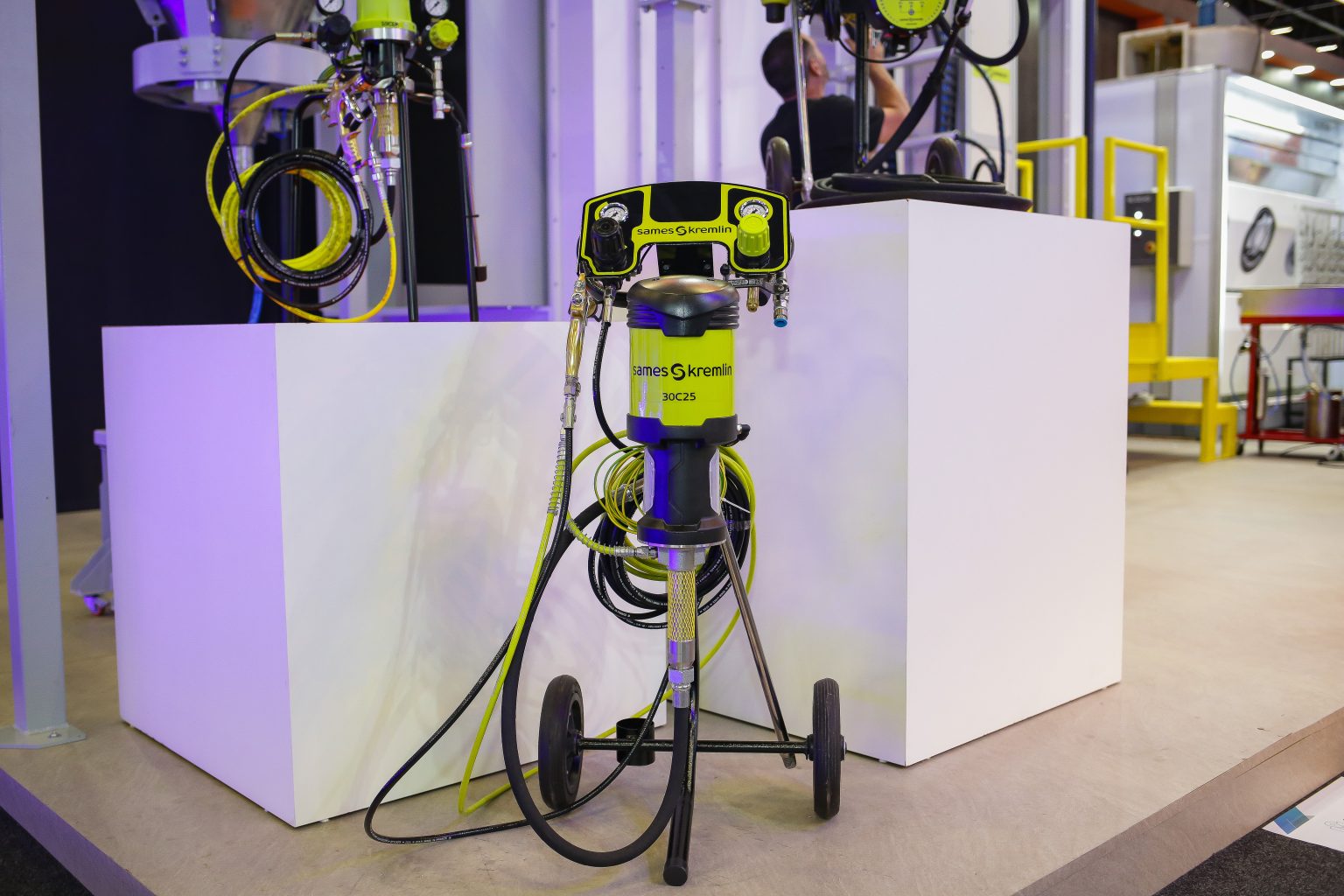
Among the various application technologies available on the market, the technology Airmix® It emerges as an excellent hybrid solution, harmoniously combining the best features of two worlds: the intrinsic precision of hydraulic spraying (Airless) and the precise control of airbrush spraying. This innovative system operates with an impressive throughput, where approximately 70% of the atomization work is driven by hydraulic pressure, while the remaining 30% is supplemented by compressed air.
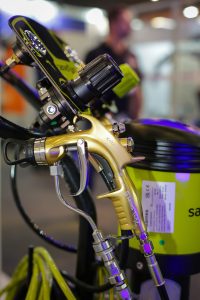
The benefits of Airmix® contribute directly to efficiency in industrial painting: one reducing the level of overspray. This feature not only translates into less ink waste, resulting in considerable savings. material economy, ...but it also improves working conditions and minimizes environmental contamination. Additionally, Airmix® guarantees a very high-quality finish, characterized by less particle formation and superior uniformity, making it the ideal choice for applications demanding aesthetic excellence and durability. The synergy between hydraulic pressure and compressed air optimizes atomization and paint deposition, raising the standard of... efficiency in industrial painting.
The influence of pressure and nozzle type on efficiency.
A thorough understanding of air pressure and the careful selection of nozzle type These are absolutely crucial elements for the efficiency in industrial painting. Inadequate pressure, whether excessive or insufficient, can trigger a series of problems. Excessive pressure, for example, is one of the main catalysts for overspray, which not only increases paint waste but also contributes to air pollution and unnecessary resource consumption. On the other hand, insufficient pressure can result in a rough and uneven finish, compromising the final quality and durability of the coating.
Similarly, the choice of nozzle should be a technical and informed decision, based on the specific viscosity of the paint to be applied and the particularities of the surface. Ensuring that the flow rate and atomization are perfectly optimized for each type of coating (from low-viscosity paints to high-solids epoxies) is a competitive advantage. This meticulous attention to technical details is what distinguishes a painting process that achieves maximum performance. efficiency in industrial painting from a purely functional process. The correct calibration of these components ensures not only material savings, but also the longevity and aesthetics of the finish.
Sustainability and environmental compliance
The growing demand for solutions for industrial painting Making them inherently more sustainable is not just a trend, but a global imperative. Reducing Volatile Organic Compounds (VOCs) Reducing ink consumption and minimizing waste are goals that directly contribute to mitigating the environmental impact of industrial operations. Advanced technologies, such as Airmix®, with its proven ability to minimize overspray, align perfectly with these regulatory and ethical requirements. They promote not only a healthier work environment for operators, but also more environmentally friendly and economically viable production processes. efficiency in industrial painting It is, therefore, a catalyst for sustainable innovation.
Towards total efficiency
THE Industrial painting in Brazil The industry is on a path of constant evolution, driven by a triad of essential factors: the need for greater efficiency, the relentless pursuit of superior quality, and an unwavering commitment to sustainability. For industries that aim not only to survive but to thrive in this competitive landscape, investing in cutting-edge technologies and in-depth knowledge of application processes is more than an advantage; it is a condition for staying ahead. Optimizing transfer efficiency and systematically reducing ink waste are not merely financial objectives; they represent a commitment to the future of the planet, to operational excellence, and to building a more responsible and productive industrial legacy. efficiency in industrial painting It is the key to unlocking a more promising future for the sector.