Powder coating or liquid coating: choosing between these two technologies is one of the most strategic decisions for those who produce metal parts, furniture, or industrial structures, and directly impacts finish, resistance, investment, and even the environmental compliance of the operation. There is no one technology that is better than the other: there is the ideal technology for what the product needs to deliver to the end customer.
Main differences between powder coating and liquid painting.
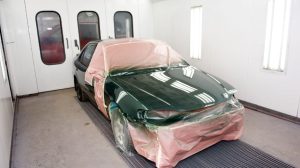
Liquid paint stands out for its diverse finishes: colors, sheens, and textures with far more variety than powder coating can currently offer. Powder coating, on the other hand, stands out for its resistance, durability, and lifespan, making it the recommended choice for products exposed to outdoor areas or that require greater chemical and mechanical resistance.
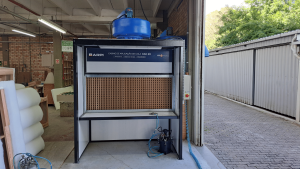
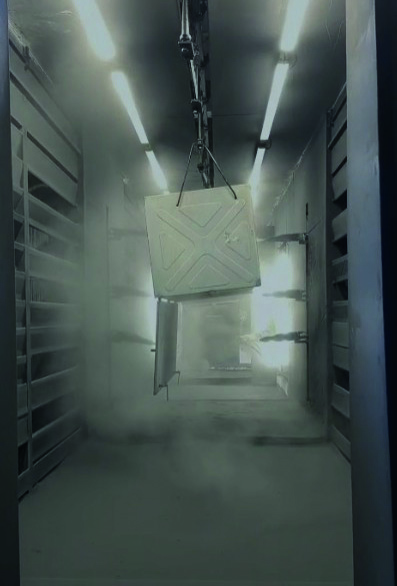
One point that is rarely discussed is the curing process. Liquid paint can cure at room temperature or in an oven, with temperature ranges varying according to the substrate: metal can withstand 100°C to 120°C, furniture and MDF a maximum of 40°C to prevent swelling, and plastic up to 60°C. Powder coating, on the other hand, requires an oven at approximately 200°C, with no alternative, making the initial investment the main limiting factor for those migrating from this technology. Therefore, large parts such as truck chassis only began to be powder coated after large-scale cabins with recovery systems made the process viable.
Environmental impact: powder coating vs. liquid coating
Liquid painting raises two key environmental concerns: the emission of VOCs (volatile organic compounds) into the atmosphere, now more strictly limited by legislation for large companies, and the generation of paint sludge and filter residues contaminated with heavy metals, which require proper disposal. Powder coating eliminates VOC emissions and, with appropriate treatment plants, can drastically reduce the environmental impact of the chemical baths involved in the process, bringing the operation closer to a closed-loop system.
Which sectors stand to gain the most from a powder coating line?
The most common cases of migration to powder coating involve products that require high mechanical and chemical resistance: aluminum profiles for outdoor use, indoor and outdoor metal furniture, furniture accessories, metal structures and chairs, among other medium and large-sized metal parts. In all these cases, a specific study is worthwhile to understand whether powder coating offers a real gain in resistance compared to liquid paint, considering the actual needs of the end customer.
Conclusion
When choosing between powder coating or liquid coating, the decision should be based on the actual needs of the product and the end customer, not on which technology seems more modern. While powder coating offers greater resistance, durability, and less environmental impact, liquid coating remains the most accessible and flexible finishing option for those who do not yet have the resources for the initial investment that powder coating requires.
To understand which solution makes the most sense for your product, Speak to a Koria specialist..